
September 26, 2020
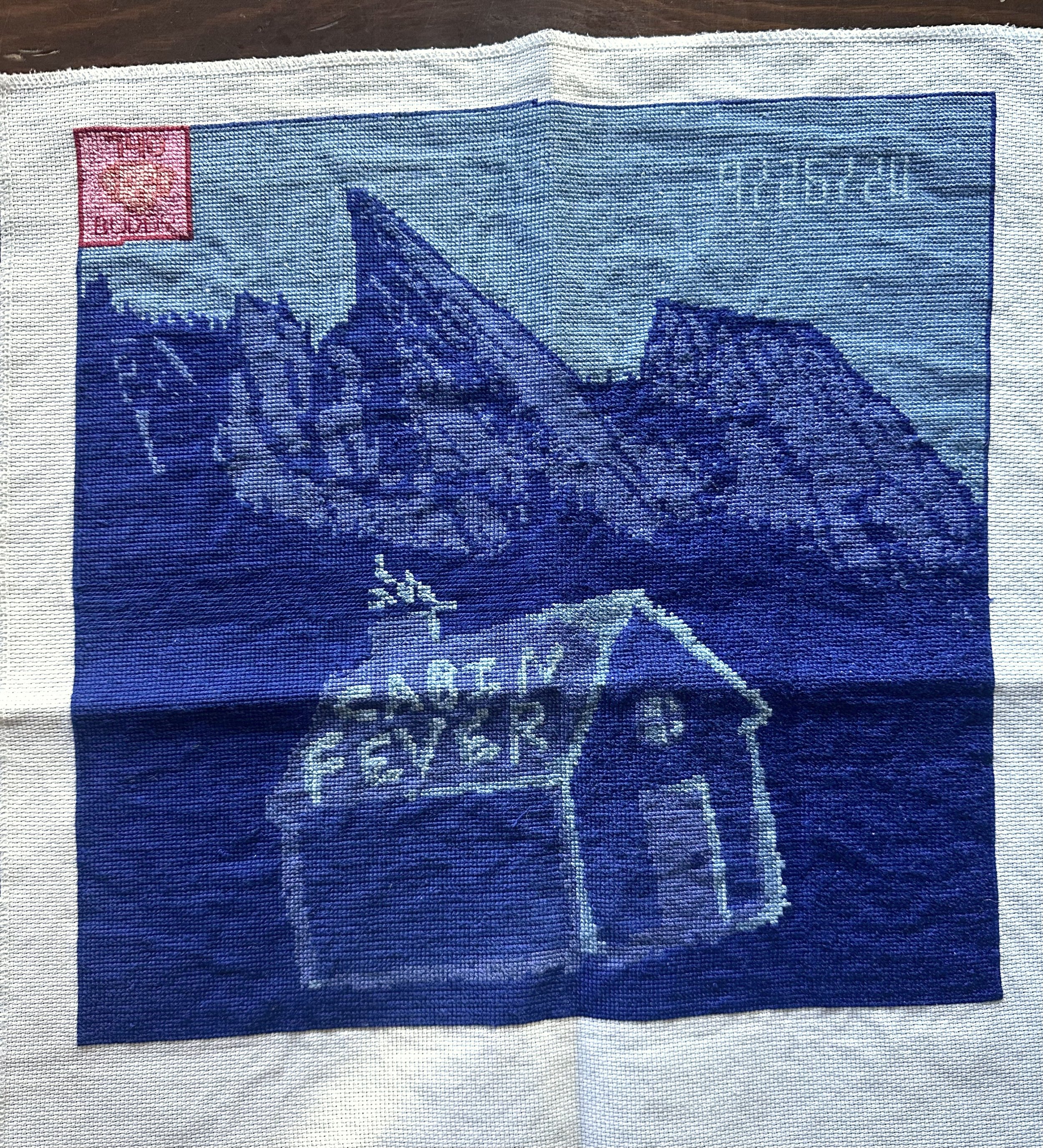
Stats:
Cases reported: 45,377
Deaths reported: 740
Size of block: 15.25” x 15.25”
Stitched by: Sharon & Deanna
Story by: Christopher
Illustration by: Stella
Location: FL & CO
This story is a transcript of an interview with an unhoused individual named Christopher, who Heather spoke with in the summer of 2023.
Heather: Let me make sure, it's working. Okay.
Christopher, if you wouldn't mind just sharing, if you were telling someone your story about what it's been like during the pandemic for you, just start wherever makes sense.
Christopher: Well, when COVID… When the pandemic started, I was kind of shocked at how it all just happened overnight, but it was also a blessing in disguise for me.
And actually, it was something that I needed to happen, considering that my dog at the time was dying, he was terminally ill. It was a degenerative nerve disease. And I had the opportunity because of COVID, I was able to stay 24/7 with my dog in my apartment and give the last, especially, that year, of the undivided attention that my dog needed.
So it was a blessing. When everyone else, it was a curse, it was actually a blessing. It's everything I could ask for because I was able to spend that time.
But then, it changed, my dog passed. Then the confinement became, and that was it, it became more of a living hell. Because I was confined, cabin fever kicked in, because, and then I, you know, so then the exact opposite happened to me. And then I was like trapped into, like I says, you know, after my dog died, it was just devastating.
He was my dog before that one [pointing to dog nearby].
H: Yeah.
C: That’s when--
H: You lost your daughter and your dog.
C: Dog, dog, dog, not daughter.
H: Okay, your dog. Let me just, sorry.
C: Okay, it's okay. So that's what happened. So it was, it was kind of symbolic, but most of the time during the pandemic, it was a blessing in disguise, 'cause I had the time to do that.
H: So just to make sure I understand correctly, your daughter had a terminal illness.
C: Dog, dog, dog.
H: Your dog, okay. So sorry, your dog had a terminal illness. You got to spend time with him. Okay, that makes sense. What was your former dog's name?
C: Buddy. That was the name that the Humane Society gave him. And it worked because he was a male lab and everyone was like, "Hey Buddy, what's up?” And I brought him up to the mountains, cause I was living in Nederland at the time.
H: Yeah. And how have things been different for you since before the pandemic versus after the pandemic started?
C: People. People… changed.
H: Yeah. In what way do you feel this?
C: People are so impersonal now. People are abrasive now. It's a lot. I don't know what psychological aspect happened at the social level. And I'm not the only one who says this, either.
You know, people… Everyone would be in line and people would say, "you're socially irresponsible. You're not seven feet away." Everyone would.
And when the society was kind of policing themselves… A lot of people still carry that racist mistrust. It's hard to articulate and put a label on it, but there seems to be a level of mistrust and abrasiveness that's, uh, developed…between one another in society during, that developed during the pandemic.
H: Yeah, and you've experienced that personally?
C: And a lot of people think. I'm not gonna go into conspiracy theories, but a lot of people think there is a lot of social control experiments going on because, you know, like, “Do we need marshall law?” Well, no, because society, it proved that society will police themselves.
Stuff like that. So, I mean, I'm not gonna go that far. There's a lot of interesting socializing things.
H: Yeah, yeah, I would agree with that. Yeah. If there is something that you hope that we can leave behind from pre-pandemic times that were no longer useful or weren't even maybe useful at that point in time, and maybe something we learned that has been helpful that you hope we bring forward?
C: Appreciation for emergency services and medical and, I'm a veteran and people always say, "Thank you for your service." Okay, fair enough.
But you know, I look at cops and EMTs and stuff like that. I think firefighters, I think, well, “Thank YOU for YOUR service.”
H: Yeah.
C: ‘You’re doing it every day.’
H: Yeah.
C: You know, and I think there's a greater appreciation for people like that, or there should be. I think there's a higher level of their importance, that they should be supported in society. So, I think that's something that, you know, post-pandemic is something that came out of it.
H: Yeah.
C: Yeah, that's one aspect. Because, um, people in emergency services are under appreciated in society, um, you know, over worked, they're underpaid.
H: Yeah. Yeah.
C: Give some of the things in life that they deserve.
H: Yeah, we've seen a lot of emergencies in Boulder County.
C: Oh, yeah.
H: A lot.
C: Right.
H: Yeah, and in particular during these three years for sure. What was the other question…?
Is there something that you have changed about like how you approach life since the pandemic started?
C: Yeah, see, it goes in line with what I said kind of happened during the pandemic about people.
Well, I've learned a lot, maybe because this is my area I pay attention to, maybe it's why I went to college for anthropology and psychology and sociology, but I dropped out, but [indecipherable] society.
I see how, and plus the president that we had at the time, Trump, I see a lot of how, I remember, uh, Nazi-Germany and learning that history, and thinking that can never happen here.
And then, seeing a president like we had where, 42% of the population believed him, even though he lied right in their face about everything. And like WOW- it could happen here.
I saw a lot of things that just, how people were socially irresponsible and lost their trust, or mistrust, the government.. and who's patriotic and who's not? I mean I saw a side of society where the alt-right could really take over pretty easily. And it can happen overnight.
H: Yeah.
C: Society— where they all can break and take over in the media. It can happen overnight.
The mentality of a lot of people.
You know, I mean they say charisma is what Hitler had. But so did Jesus Christ, so was Ghandi. But… so then Charles Manson, and then the FBI, they profile charisma with religious cult leaders, and that's one thing.
But our president at the time must have had charisma. It didn't work on me, but enough to brainwash a lot of Americans…a lot of Americans into being in line now.
H: Yeah.
C: In my eyes.
H: Yeah, I definitely would agree with you there.
C: Right. So it could happen.
H: Absolutely.
C: It could more than we ever thought.
H: Absolutely. Is there anything else you'd like to share?
C: COVID was a very interesting social experience, whether you wanted to believe what some of the conspiracy theorists come up with, you know, like, you know, it was testing for martial law, mind control, this, that, that.
So I'm like, what would happen? Everything.
I mean, if you want to go that far in deep or in a paranoid aspect, or if you just want to look at how we change, you know, how society adapts to some different settings and whether it be war or you know, pandemic, something like that, you name it.
It was an interesting world experience.
H: Yeah.
C: You know, the confinement and dependencies, or the lack of dependency that we developed for certain things, was probably an experience that we're taking with us for life.
And like all experiences, you know, we should learn from them and gain wisdom from it.
I hope, you know, I hope many did that.
H: That’s great. Okay.